Wonderful Merline: A Handwritten Font That Feels Like Home
It was a quiet Tuesday morning—coffee steaming, candle wax still soft on my worktable—and I was tweaking the label for my new lavender-vanilla soy candle. The design felt right: clean kraft paper, a simple line drawing of a sprig, and just enough text to whisper “hand-poured” without shouting. But the typeface? It kept falling flat. Too stiff. Too generic. Then I opened Wonderful Merline.
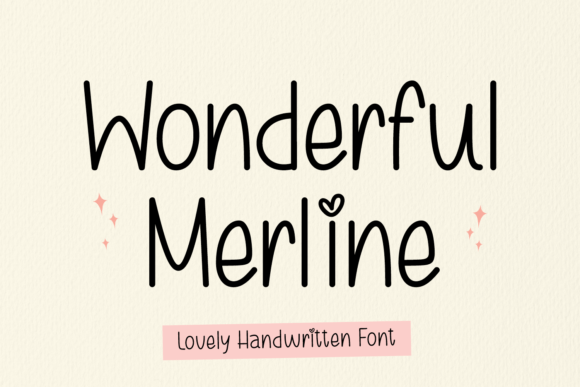
Right away, it felt like picking up a favorite pen—the kind with just the right weight and flow. Wonderful Merline is a warm, flowing handwritten typeface with gentle pressure variation, subtle bounce, and delicate entry/exit strokes. It’s not overly ornate or fussy; instead, it carries the relaxed confidence of someone who writes beautifully without trying too hard. There’s a softness in its curves, a sincerity in its rhythm—like handwriting you’d trust on a love note or a thank-you card tucked into a gift box.
I dropped “Lavender & Vanilla” into the label mockup in Wonderful Merline, sized it at 18pt, and stepped back. Instantly, the whole piece softened and warmed. It didn’t look mass-produced. It looked *made*. That’s the quiet magic of this font: it doesn’t just say words—it carries tone, care, and craft.
Since then, I’ve used Wonderful Merline across real projects—not just mockups, but finished goods that shipped, printed, and sat on shelves. On kraft sticker sheets for jar labels? Yes. On folded greeting cards for birthdays and baby announcements? Absolutely. For wedding invitation suites—especially those with botanical motifs or rustic textures—it adds an intimate, personal touch that digital fonts often miss. And for printable wall art? It turns simple quotes like “Breathe” or “Gather Joy” into something tender and grounded.
What makes Wonderful Merline especially practical for makers is how well it holds up at different sizes and applications. At 10–12pt on small product tags (think mini tea tins or soap bars), it stays legible—especially when printed crisp on matte sticker paper. For larger uses—like a farmhouse-style wooden sign or a tote bag print—I bump it up to 36pt or more, letting its natural swashes and ligatures breathe. The font includes alternate characters and contextual ligatures, so “love,” “forever,” and “hello” each get their own graceful connection—no manual tweaking needed.
Of course, I always test before cutting or printing. With Cricut Design Space and Silhouette Studio, I convert Wonderful Merline to outlines first for clean cuts—especially on vinyl stickers or iron-on transfers. For digital downloads—planner pages, quote prints, or editable Canva templates—I embed the font properly and include clear usage notes so buyers know it’s licensed for commercial use (yes, it is—check the license file for physical products, merch, and templates).
Wonderful Merline shines brightest as a display font—not for long paragraphs, but for names, titles, short phrases, and decorative emphasis. Think “Est. 2023” on a boutique tag, “Hand Mixed” on spice labels, or “You Are Loved” centered on a framed printable. Its personality means it pairs beautifully with quieter companions: a clean sans serif like Montserrat or Poppins for body text or pricing; a gentle serif like Playfair Display for contrast in invitation suites; or even another script—but only one, and only when their rhythms complement, not compete.
I’ve layered it with minimalist line art for seasonal sticker sheets (think pumpkins in October, snowflakes in December), and it never overwhelms. On mug designs, it wraps cleanly around curves when warped subtly in Illustrator. On cotton tote bags, screen-printed in soft black ink, it reads as both intentional and effortless. Even in social media graphics—Instagram story highlights or Etsy listing banners—it draws the eye without demanding attention.
One thing I always double-check before finalizing any design: file format and language support. Wonderful Merline comes in OTF and TTF, works smoothly in Adobe apps, Affinity, Canva (via upload), and most cutting software. It supports basic Latin characters and common diacritics—perfect for English, Spanish, French, and German shop names or greetings. No extended Cyrillic or Arabic glyphs, so I keep that in mind when designing for broader multilingual markets.
Its inclusion of stylistic alternates and swash capitals has saved me time more than once—like swapping the standard “W” for a flourished version on a wedding welcome board, or using the lowercase “g” with its looping tail on a planner cover. These details don’t shout, but they’re noticed—by customers flipping through your Etsy shop, by brides comparing invitation vendors, by fellow makers scrolling your Instagram feed.
That’s where Wonderful Merline quietly strengthens brand identity: consistency without repetition. Using it across labels, cards, digital previews, and packaging creates visual harmony—even if your color palette shifts seasonally. A customer who buys your spring candle today will recognize your summer lemonade mix label tomorrow, not because the colors match, but because the handwriting feels like the same steady hand behind them both.
And yes—it’s a Script Amp font, part of that thoughtful category of expressive, high-quality script fonts designed specifically for creative professionals and small business owners. It’s not a free download with hidden limits. It’s a premium font built for real commerce: tested for readability, engineered for versatility, and licensed for resale—whether you’re selling physical goods, printable PDFs, SVG files for crafters, or custom-branded merchandise.
So if you’re choosing a font not just for how it looks, but for how it makes your work feel—inviting, sincere, unhurried—give Wonderful Merline space on your design desktop. Try it on a label. Print it on a cardstock swatch. Cut it from vinyl. See how it moves with your voice. Because the best typefaces don’t just hold words—they hold meaning, memory, and the quiet pride of making something by hand.